.svg)
Diversified growth – with a focus on stability, efficiency, and customer proximity
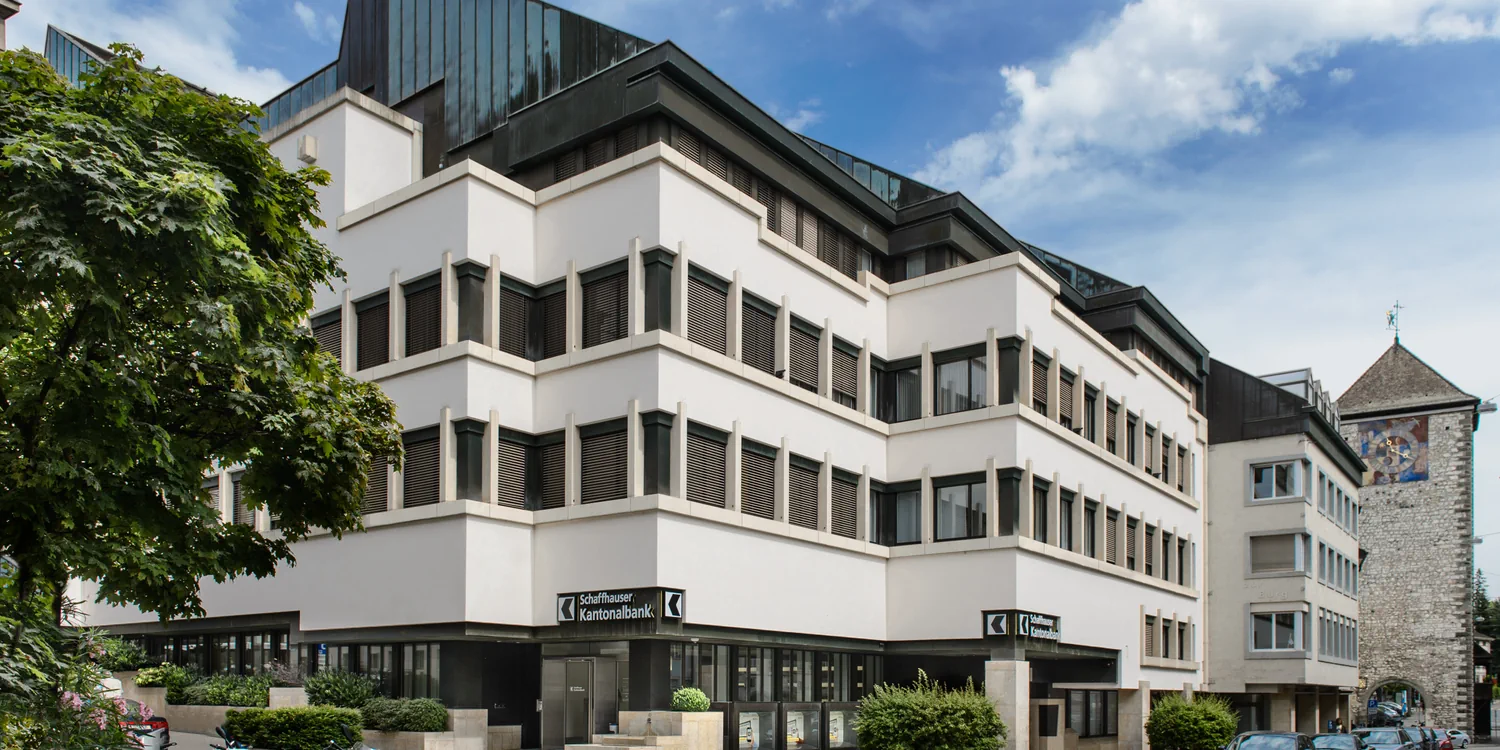
Schaffhauser Kantonalbank is the leading financial institution in its economic region and has close ties to Schaffhausen and its residents. Around 370 employees work at its locations in Schaffhausen and Stein am Rhein. The modern universal bank offers comprehensive financial services to private individuals, companies, and public institutions.
As one of the best-capitalized banks in Switzerland, it creates security for customers, employees, and owners. Its performance is also impressive, despite being impacted by the current low interest rates. Positive momentum is coming from the commission and services business as well as from trading activities. The bank is consistently implementing its strategic focus and investing in sustainable development and diversified growth.
As part of its annual retail banking study, IFBC spoke with Alain Schmid, CEO of Schaffhauser Kantonalbank, about the factors for success in a demanding market environment and the challenges of financial bank management. In the following interview, he provides insights into his current market assessments and the factors for success at Schaffhauser Kantonalbank.
As Schaffhauser Kantonalbank, we are deeply rooted in the region and analyze the economic situation in our annual economic report. Gross domestic product grew by +2% in Schaffhausen in 2025, and the forecast for 2026 is +1.7%. According to BAK Economics, this puts us above the figures for eastern Switzerland and Switzerland as a whole. This is even though Schaffhausen is heavily industrialized and exposed to the major challenges facing this sector: increased customs duties, a strong Swiss franc, and significant price pressure. These factors, combined with weak global demand, are weighing on local market players in the sector industrials. On the other hand, the pharmaceuticals & chemicals, packaging, services, and healthcare sectors continue to provide growth and stability. Our own market environment is characterized by intense competition, ranging from large banks to smaller institutions with 20-30 employees. Retail banks are naturally challenged by the current 0% interest rate environment – but as the strongest local bank, we are well positioned.
It is in our DNA to be committed to the community and therefore very customer-focused. One example is digitalization: we are deliberately not a digital bank, but use digital tools to simplify the lives of our customers and our employees. We provide highly personalized support for assets of all sizes and take the time to cultivate authentic relationships and share valuable knowledge. For example, we teach young people in Schaffhausen school classes how to draw up a budget, what effect compound interest has, and how to manage money. As soon as they earn their first salary, we help them with tax and pension issues and show them what to consider when it comes to complex transactions such as buying a house or inheriting money. We advise our customers on financial matters with professionalism and conviction, across generations. We also enjoy the trust of our international customers, the majority of whom come from Germany.
Personal accessibility makes all the difference for us. We have invested in a high-quality contact center, which we maintain locally in Schaffhausen and where our customers can obtain information quickly, easily, and competently. If someone needs help with online banking, they don't have to wait forever on hold on a hotline. Our physical "digital lounge" at our headquarters is also popular with young and old alike, as it allows them to test digital offerings informally on smartphones and other devices. We also sometimes explain to customers how to order a pair of shoes online and pay with Twint after they have opened an account, or we print out a document from e-banking with them. It is these simple things that make our customer experience unique and highly valued. Personally, I enjoy spending time in the open atmosphere of our lounge and hearing directly from customers and employees at the coffee bar about what matters to them. Credibility is another multiplier: for example, our pension advice is consistently independent of other banking services, and our experts have no quantitative targets. Customers perceive this immediately and very positively, which pays off for everyone in the long term. Our customers and their money are safe and in good hands with us.
That's an interesting question. Without a doubt, this technology opens up a huge range of possibilities. We are very conservative when it comes to customer and employee data and have great respect for autonomous AI decisions. Accordingly, we are not a "forerunner" in AI. On the other hand, we consistently use modernization in established software applications wherever we can accelerate or improve processes, for example in text creation. In the IT area, we use chatbots for internal support and AI-based libraries in software development, and our experiences with this have been positive. However, these are all applications that do not pose any risks to confidentiality.
Regulation is part of banking and forms the basis for trust. It follows the principle of proportionality: the smaller and less risky a bank is, the less complex its regulatory supervision should be. The risks of Schaffhauser Kantonalbank are monitored appropriately by senior management. In the wake of crises in the Swiss financial and banking sector, additional requirements and a regime for large, systemically important institutions have been introduced. Most of the requirements for large institutions now also apply to small and medium-sized banks, and the principle of proportionality is coming under increasing pressure. When we consider the capital requirements that are sometimes demanded, we must take great care to ensure that these do not impair the competitiveness of Swiss banks. Governance and reporting obligations, as well as the associated costs, must continue to be proportionate to a bank's risk profile in the future.
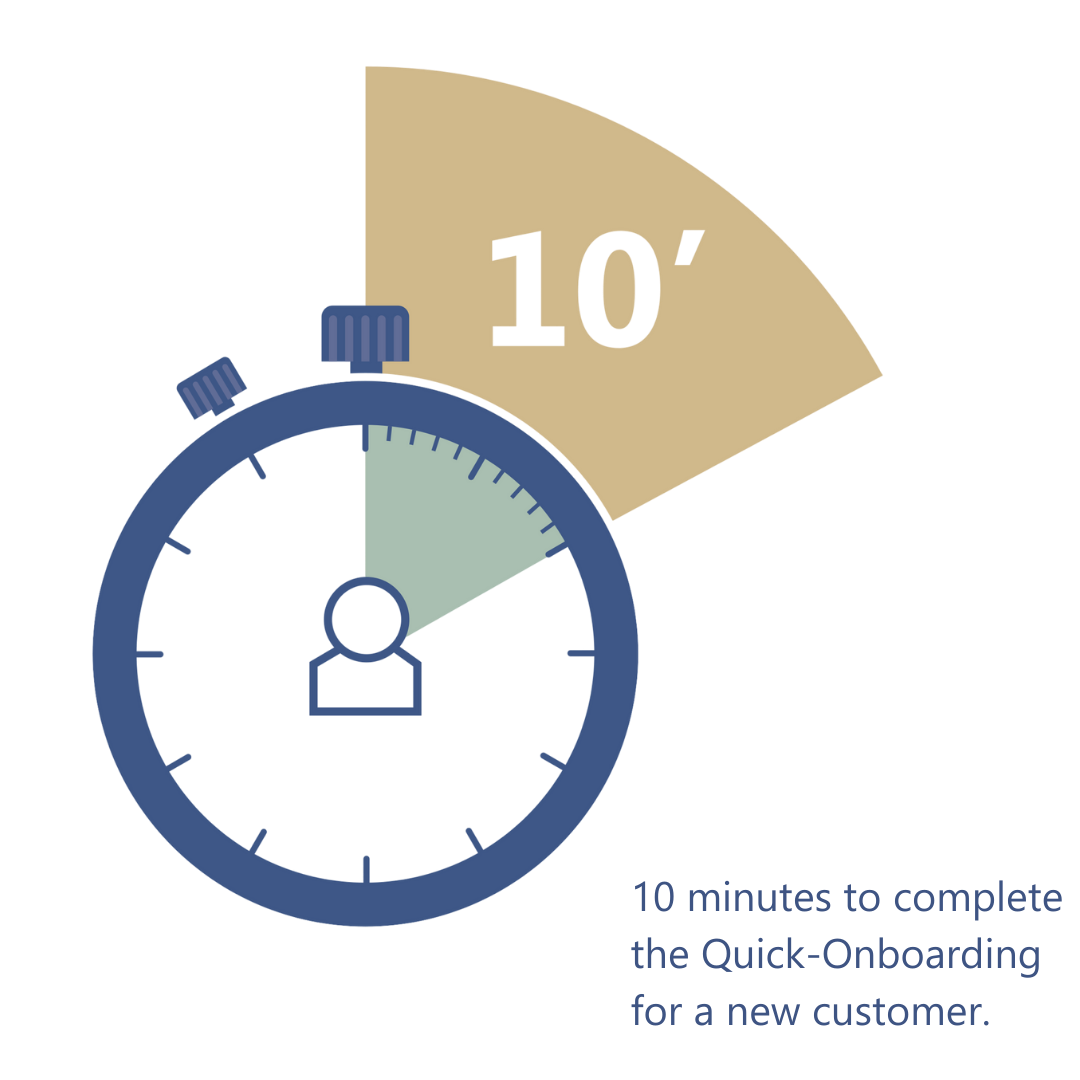
First of all, you have to understand a bank's earnings side and the general conditions it operates under. We have a large share of money market mortgages and are earning less in the current 0% interest rate environment than we did in the last two years. This will have an immediate negative impact on our cost/income ratio. Investment cycles and the associated cost fluctuations also play a major role in this consideration. Accordingly, the cost/income ratio is important, but it is not the all-encompassing key figure. We expect to have a cost/income ratio of +/- 50% in the future, as we also make conservative write-downs. On the cost side, focus is the recipe for success. We analyze our business cases in detail and do not "dress them up." Once we have prioritized the projects (e.g., quick onboarding at the bank counter) according to their expected value contribution, we implement them very consistently.
I also see this trend toward consolidation. Small banks are coming under increasing pressure due to rising regulatory costs and stricter capital and liquidity requirements. They are also no longer able to bear the full burden of investments in digitalization. This also involves the operation of fraud prevention, cyber security, etc. Accordingly, a bank's strategic positioning is of central importance for its long-term success.
We are currently one of the best-capitalized banks in Switzerland. However, with Basel III final and higher capital consumption, we will also continuously review our capital allocation and optimize it to maximize its benefits for us. In addition, we are gradually shifting our financial management from a volume-oriented approach to a profit-oriented one. In the future, we want to gain an even better understanding of where we earn how much money.
Digital tools and AI will naturally continue to gain importance in banking during this period. With certain topics such as neobanks and stablecoins, it remains to be seen how high the level of acceptance in the market really is. When it comes to transactions such as buying a house or inheriting property, where trust plays a key role, the next generation will also value face-to-face conversations. That's why I'm convinced that interpersonal relationships will continue to be crucial in the future and that there will still be room for traditional Swiss retail banking in ten years' time.

Alain Schmid has over 30 years of experience in the financial sector. He began his career with an apprenticeship at Zürcher Kantonalbank. He held various key positions at Credit Suisse until 2023, most recently as Head of Business Banking for commercial clients and responsible for payment transactions at Credit Suisse (Switzerland) AG. He served as CEO of the technology and software company Fides Treasury Services AG from 2012 to 2016. Alain Schmid holds an Executive MBA from the University of Zurich and holds various board positions in the financial sector.



%202.webp)


